
The Mission to End Modern Slavery Commemorates National Human Trafficking Prevention Month and Marks 10 Years of Building Migrant Worker Power in New York City and Beyond!
The Mission to End Modern Slavery Commemorates National Human Trafficking Prevention Month and Marks 10 Years of Building Migrant Worker Power in New York City and Beyond!
MEMS looks back at our work during the first year of Trump 2.0 and lauds the fights migrant workers waged against exploitation, abuse, and trafficking.
The Work We Accomplished
In 2025, MEMS continued to build the capacity of migrant workers and community partners to organize to fight labor trafficking wage theft against the backdrop of a repressive immigration landscape.
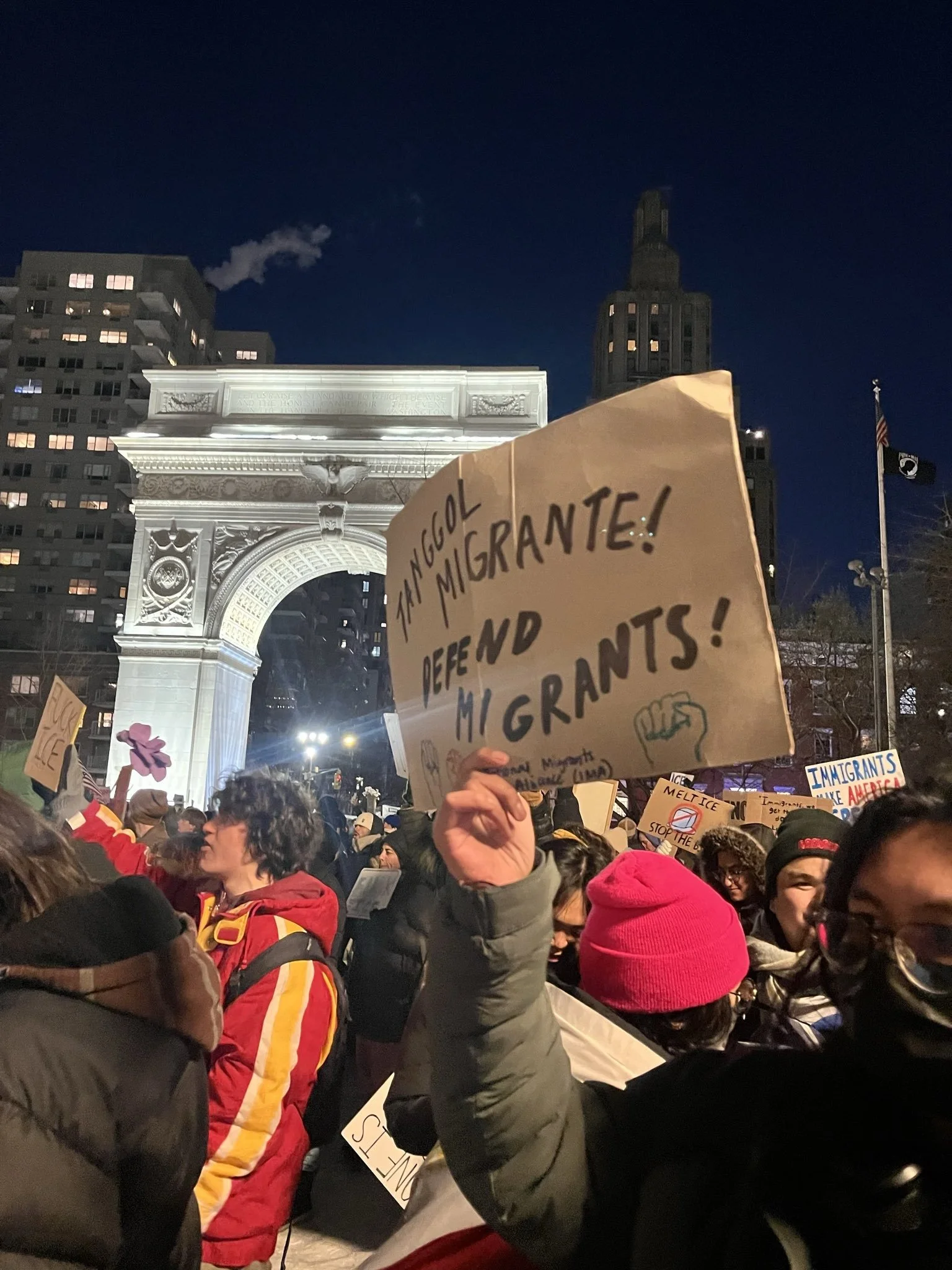
Supporting migrant workers in detention - Alongside our community, we fought for the release and human treatment of Dhenmark and Jovi, two Certified Nursing Assistants (CNAs) from the Philippines, from immigration detention. We advocated on their behalf to receive aid that they were entitled to from the Philippine Consulate in New York’s Assistance-to-Nationals (ATN) fund for distressed migrants. The Philippine Consulate refused to disburse this fund or regularly check up on Dhenmark and Jovi, exposing the mistreatment and neglect by their home government as well as by ICE in detention. Although Dhenmark and Jovi returned home, their resilience against the repressive immigration system continues to inspire other migrant workers across the U.S. to fight. MEMS was part of the Tanggol Migrante Movement/Defend Migrants Alliance. We consulted with campaigns to free detained migrants and helped them navigate immigration policy changes in a way that empowered migrants in detention to fight. We joined trainings on building community-based ICE rapid response networks and how to file habeas petitions to free migrants from prolonged detention.
Holding labor traffickers accountable - MEMS advocated on behalf of the Florida 15, survivors of labor trafficking from the Philippines who have been seeking justice against their trafficker, Jojo Villanueva, who trafficked them into the hospitality industry in 2008 and went into hiding for over a decade until he was arrested by authorities in the Philippines in 2024. With our support, and despite expensive fees and confusing government bureaucracy, members of the Florida 15 were able to testify in Virtual Court Hearings at the Philippine Consulate to offer detailed testimony of Villanueva’s harm against them and bring him closer to justice. MEMS commits to ensuring that the Florida 15’s voices are not silenced in the justice process and that Villanueva is held accountable.
Joining the Justice for Filipino Caregivers Campaign - With Migrante New York, a grassroots organization of Filipino migrant workers, at the forefront, MEMS joined the Justice for Filipino Caregivers campaign, which initially launched to support the fight of migrant caregivers demanding thousands of dollars of stolen wages and justice from their employers who trafficked them in the Bronx. MEMS helped create spaces for the caregivers to share their stories and strategized alongside them to identify their targets and demands. The campaign has since broadened to include all Filipino caregivers and encourages others to share their stories and join the ranks of migrant workers fighting back against wage theft and labor trafficking in New York City and beyond.
Practicing community safety side-by-side with migrant workers - Additionally, MEMS coordinated and provided accompaniment to asylum interviews, biometric appointments, ICE hotspots, and court appearances. MEMS assisted survivors of domestic violence, particularly through seeking orders of protection and navigating immigration proceedings. We helped build a community support system for migrant workers facing detention and deportation proceedings, including neighborhood mutual aid, ICE watch, domestic violence survivor circles, advocacy for assistance to national campaigns from migrants’ home countries, and caravans to accompany migrant workers to immigration court hearings and interviews that supplemented their legal defense.
“Building Strength to Break the Chains” Program - The intensifying political situation revealed the need to educate our communities the inner workings of the immigration system and its intersection with the criminal system. Thus, MEMS shifted its organizing focus towards mass education on labor trafficking, “crimmigration,” law enforcement encounters, risk assessment and safety planning, and intake interview trainings. Through our “Building Strength to Break the Chains” program, MEMS has trained 66 migrant workers and community partners in intakes and Know Your Rights trainings (KYRs), which resulted in 23 intakes and 5 KYRs.
Building the movement - MEMS strengthened our alliance building and grassroots organizing networks with the formation of the Queens-based Tanggol Migrante Movement coordinating committee, the revival of the New York chapter of the International Migrants Alliance to establish solidarity across different migrant nationalities around the world, and relationship-building with local elected officials to support grassroots campaigns and brainstorm legislation that would curb international labor trafficking by regulating foreign labor recruitment.
Stories from the Ground - A Summary of Intake Interviews with Migrant Workers
Through 23 intake interviews with Filipino migrant workers across New York City, and surrounding areas such as Jersey City, Philadelphia, and Boston, MEMS traced ongoing and uncovered new recruitment trends and possible labor trafficking schemes. These migrants worked mostly in domestic work (domestic workers, nannies, babysitters) and health care (nurses, CNAs, physical therapists [PTs], caregivers, “nutrition aids”). Their immigration legal statuses varied. Most common were undocumented migrants who traveled to the U.S. on tourist visas, overstayed past the six months, and found unauthorized work, often instructed by recruiters to do so. H-1B visas for Filipino workers tend to be rare because of the high demand and competition. Recruitment agencies will enter workers into the H-1B lottery but would mischaracterize their professions (e.g. an agency hiring a Filipino to be a PT submitted them into the lottery as an “exercise physiologist”). A batch of nurses received the EW-3 green card, a category for “unskilled workers.” While they were sponsored through this program successfully, nursing is not an “unskilled” profession, requiring less than two years of experience or training. Additionally, they also faced employment law violations to further exploit them. Lastly, we saw large batches of Filipino workers brought over on particular non-immigrant visas (e.g. student F-1, exchange visitor J-1, tourist B-1/B-2). The recruitment agencies place them in vulnerable situations that expose them to heightened immigration enforcement, while employers continue to profit off their unpaid contractual labor.
Filipino migrant workers are victims of fraud, wage theft, and abuse in their workplaces. All of these experiences are red flags and elements of labor trafficking. First, recruitment agencies commit employment contract fraud to entice Filipinos to work abroad, promising full-time jobs, competitive salaries, and green card sponsorship. However, upon arrival, none of the terms are upheld. First, many are forced to sign unlawful non-disclosure agreements, non-compete agreements, and buy-out clauses to scare them into staying in these exploitative gigs. Second, in every instance, migrants experienced wage theft in different forms: unpaid work, delayed pay, lower rate than promised, lower rate than industry standard, below minimum wage, recruitment agency cut, and lower contractual employee rate than permanent employee rate. Third, almost all migrants reported additional duties outside of their contractual job descriptions. Conditions are ripe for this especially for domestic workers and caregivers given the nature of their industry and lack of formal agreements. Lastly, different forms of harassment and abuse are seen across industries. Most of the time, it’s verbal or physical harassment, but in more egregious cases, like of the Bronx caregivers, sexual harassment and abuse are rampant. Workers face immigration-related threats (e.g. reporting to ICE, won’t sponsor green card) and contract-related threats (e.g. sue under buy-out clause).
In the Philippines, it is illegal for foreign companies to recruit Filipino workers directly, so everything is done through recruitment agencies. These agencies must be licensed by a Philippine government agency, previously called the Philippine Overseas Employment Administration (“POEA”) and now the Department of Migrant Workers (“DMW”). The DMW website has a database to verify if an agency is registered. It is not an open database to scroll through but requires searching either variations of the agency name or their registration number. In one case, an agency did not show up as registered at all, not even an expired registration, even though a registration number was listed in the agency’s materials.
There are generally three types of international employment recruitment:
Direct recruitment by facility: Not viable under Philippine law
Recruitment agency: Agency match-making worker and employer then direct hire by employer
Staffing agency: Agency hires worker and assigns/places them in facility/facilities
Two recruitment practices that are of particular concern deviated from familiar trends:
Direct recruitment by “attorneys”: Migrant workers only interacted with one individual who purports themselves as an attorney. The attorney is usually licensed as such in both the U.S. and the Philippines. The individual/attorney runs somewhat of a “human resources” company that offers its services to employers to manage foreign workers for them. Most harassment and threats came from this individual, rather than the employer itself.
U.S.-based recruitment: There are agencies based in the U.S. but operating in the Philippines. They also recruit migrant workers already present in the U.S. The recruitment process for those already in the U.S. is still prime for trafficking though. Crossing nation borders is not a necessary element of trafficking.
Making Sense of Repressive Immigration Policies and How They Impact the Migrant Worker Movement
Attacks on immigrants are not a Trump phenomenon alone, but his administration fundamentally changed policies on an unprecedented level. Trump is utilizing all arms of the government to target non-citizens and even dissenters: (1) The administration primarily increased enforcement through further criminalizing immigrants, expanding existing laws and policies, specifically “mandatory detention” and “expedited removal.” (2) It is also weaponizing national security, using the same laws to target immigrants, pro-Palestine activists, and Muslim and South Asian communities. (3) Additionally, Trump is weaponizing bureaucracy by militarizing civilian agencies and creating complications and confusion. (4) Lastly, immigrants are repressed through fear and sheer force. Workplaces, churches, schools, homes, and communities are no longer safe but now targets of hostile law enforcement. Immigrant survivors, historically afforded extra protections, are now fair game for detention and deportation.
We worked primarily with the Filipino migrant community in 2025 and intimately came to understand the difficult position they are placed in between a repressive US political landscape and negligent treatment from their home government. The Philippine government virtually abandons its citizens abroad facing intensified immigration repression. At the beginning of the Trump administration, Philippine Ambassador to the US Jose Romauldez first reassured Filipino migrants that as long as they follow the laws and don’t commit crimes then they’d be safe under new immigration policies. As immigration enforcement began to increase, Romauldez and the Philippine Department of Foreign Affairs (DFA) denied any arrest, mistreatment, or deportation of Filipino migrants, despite confirmed accounts. Instead, their policy was to advise Philippine nationals to “self-deport” and delay any aid to migrants in distress. Migrant workers must be treated with dignity and respect by sending and receiving countries and not be used as fodder in intergovernmental or geopolitical contracts and disputes.
MEMS’s Commitments in 2026
With a very small team and an active volunteer network, MEMS was able to respond to the growing and dire needs of migrant workers fighting exploitation and repression in New York City and beyond. We learned many lessons about our community’s needs and how to best tailor our services to ensure that migrant workers are empowered to lead the fight.
In 2026, we commit to:
Continue offering trainings to migrant workers and community partners to expand the capacity of migrant workers to organize in New York City and beyond!
Expand our own capacity to offer and make our services accessible to other migrant groups, with language justice at the core.
Deeply investigate and expose the recruitment agencies operating in New York City and migrant sending countries who are bartering migrant workers for profit. No longer can they operate with impunity and prey on the desperate situations migrants face after being forced to migrate because of economic instability, wars, and climate catastrophes in their home countries.
Strengthening our partnerships with other grassroots organizations, migrant worker-serving institutions, and government leaders to hold labor traffickers and unscrupulous employers accountable through grassroots-led campaigns, service provision, advocacy, and legislation.
Commemorate our 10th anniversary and laud the migrant workers who have inspired us to keep serving their cause to end modern slavery and economic exploitation!
Please donate to MEMS to sustain our commitments this year! www.memsnyc.org/donate