Opening Remarks from MEMS Executive Director at "Filipino Migrants Speak: A Grassroots Examination of the Global Compact on Migration"
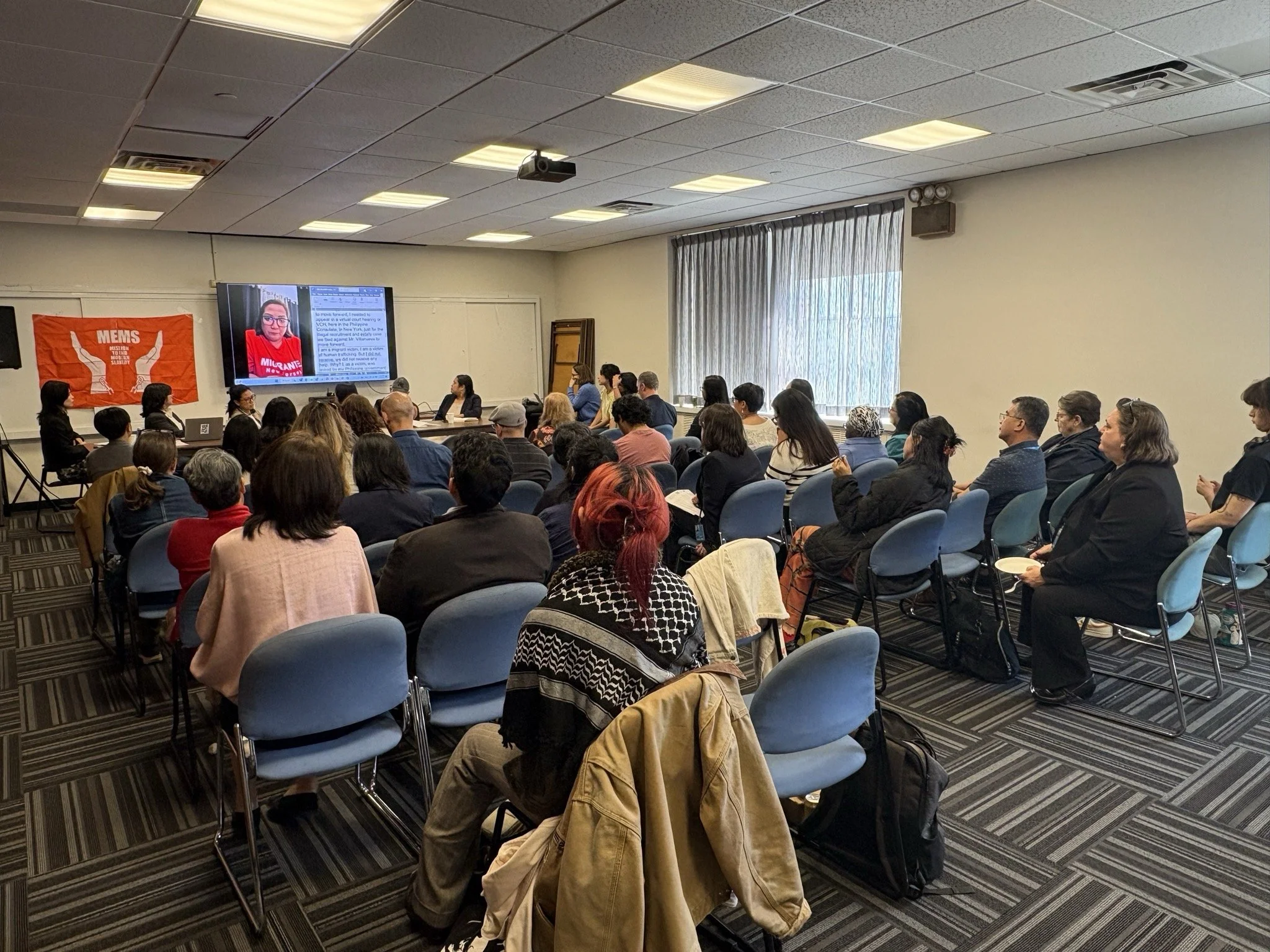
This blog features the opening remarks made by MEMS Executive Director Jackelyn Mariano at an event called “Filipino Migrants Speak: A Grassroots Examination of the Global Compact on Migration.” “Filipino Migrants Speak” took place on May 7, 2026, at the Church Center for the United Nations, and was co-organized by the New York Committee for Human Rights in the Philippines (NYCHRP). The event coincided with, and sought to respond to, the United Nations’ 2nd International Migration Review Forum. It has been edited for clarity.
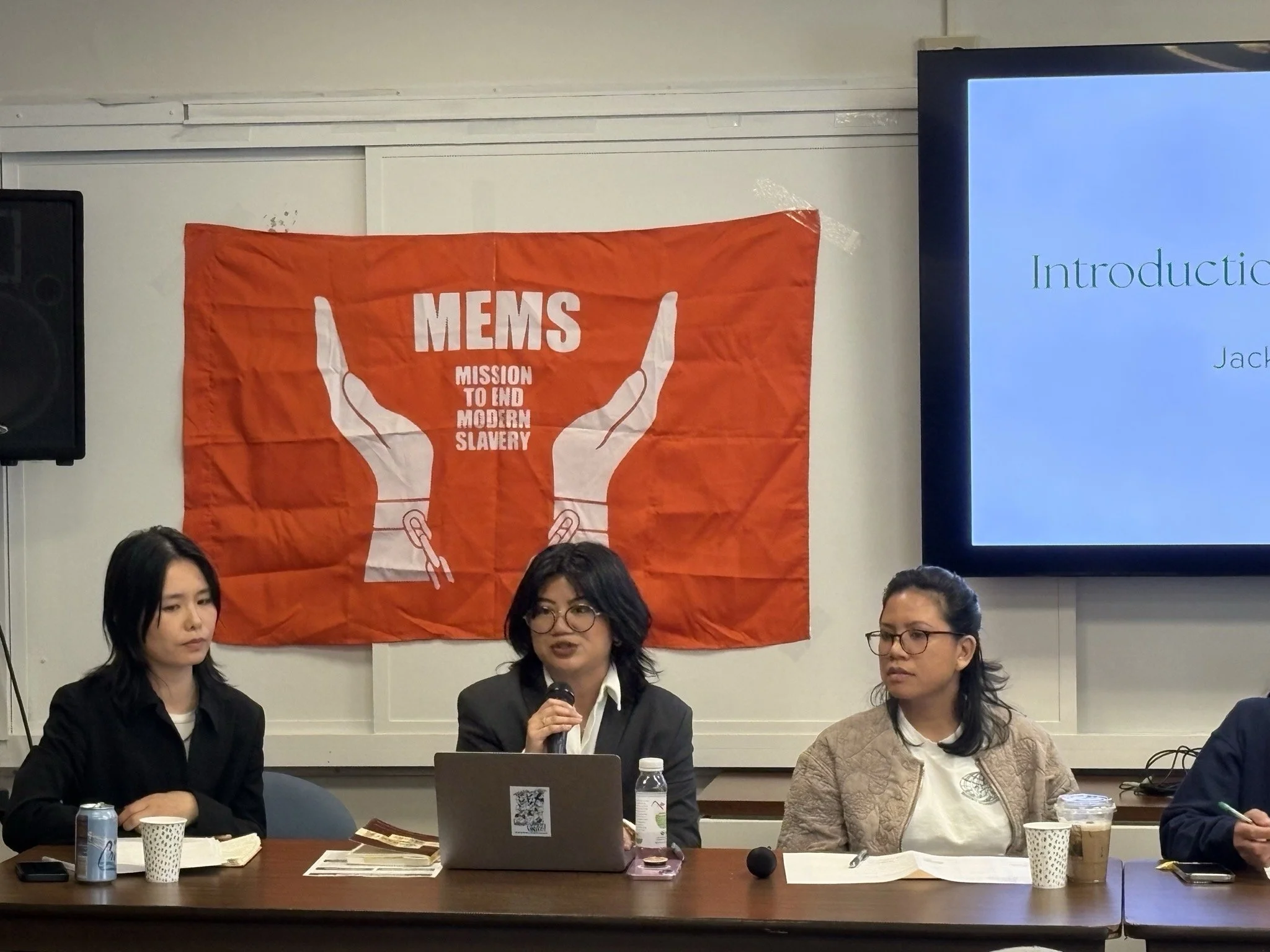
The Mission to End Modern Slavery is a small nonprofit that grew out of grassroots activism led by Filipino migrant workers fighting labor trafficking in various industries. We’re from a community that developed in Queens, New York, the heart of the Filipino and other migrant communities who found themselves in this destination by navigating the Philippines Labor Export Program (LEP) and forced migration. LEP is a term that the Filipino migrant worker movement uses to politicize so-called “labor mobility” and “migration management” and to place the current state of labor migration in the socio-historical economic context of neoliberal globalization.
The Philippines was granted independence by the US in 1946, one year after the United Nations was founded. This independence was only in name, as the US instituted a neocolonial economic system that guaranteed their power and legal rights over Philippine land and resources, such as through the Parity Amendment initially enshrined in the Philippine Constitution. International financial institutions like the International Monetary Fund and the World Bank helped maintain this economic power imbalance by lending money to the Philippines for economic development as long as it agreed to structural adjustment programs that organized the local economy for multinational corporate interests, a dynamic we have come to accept as the “free market.” Ferdinand Marcos, Sr., the infamous Philippine dictator who ruled the Philippines from 1965-1986, instituted Martial Law in 1972, forcefully solidifying the Philippines’ export-oriented, import-dependent economy. In 1974, Marcos codifed the Labor Export Program in the Labor Code. Then in 1982, he formed the Philippines Overseas Employment Agency (POEA) to facilitate the training, recruitment, authorization, and tracking of Overseas Filipino Workers (OFWs).
While the Philippines and other UN member states craft their progress declaration for their implementation of the Global Compact on Migration, MEMS seeks to bring to the surface the actual problem with migration: when migration management is treated like running a capitalist business. In 2003, Philippine President Gloria Macapagal-Arroyo stated the following to encourage U.S. businesses to recruit and hire Filipino workers. She said, “Not only am I the head of state responsible for a nation of 80 million people. I’m also the CEO of a global Philippine enterprise of 8 million Filipinos who live and work abroad and generate billions of dollars a year in revenue for our country.” The LEP has proven to be lucrative for the Philippines. In 2025, Filipino migrants sent $39 Billion to the Philippines. Yet the Philippines remains severely underdeveloped and the economic crisis worsens.
MEMS’ critique of the GCM is that it does not tackle the roots of economic forced migration. While it states its commitment to uphold human rights, the framework is unwilling to shake up the status quo. Rather, it maintains neocolonialism as the policy. It promotes and normalizes the hyper-exploitation of workers in the Global South, by outsourcing manufacturing there to circumvent labor standards won victoriously by the working class in the Global North. It promotes and normalizes the exploitation of migrant workers through temporary guest-worker programs, perpetuating xenophobia and the disposability of migrant workers.
MEMS formed to synthesize the experiences of migrant workers in this economic system. We seek to empower them by helping them understand their place in the system and their leadership role to assert their rights, and assert systemic change that ends the racialized/racist hierarchical global division of labor, and fight for a society where migrant labor is no longer commodified and devalued under the guise of development. The wages they earn should go back to them, and not the pockets of government officials. We have to ask to whom do the profits of migrant labor go?
The Philippine state is plagued with corruption scandals, like the Ghost Flood Control Projects that drew national ire when it was revealed that between PHP 42 Billion and PHP 118 Billion were drained from the Philippine economy instead of being invested in much-needed infrastructure in a country slammed by climate emergencies. The minimum wage in the National Capital Region is PHP 695 a day. which is only about $10. With the dwindling worth of the PH Peso (today, it’s worth now about 61 pesos to a dollar - the cost of a kilo of rice), Filipino families struggle more and more to live, and are forced to work dirty and dangerous jobs abroad. The economic crisis is fueled by US-led wars in West Asia. Despite the war, Migrante International reports that Filipino migrant workers in West Asia have stated that they would rather die immediately at the hands of US-funded bombs rather than go back home to the Philippines and die a slow death of starvation. Filipino workers are pressured to leave the Philippines in droves, while those who stay and assert people-centered development are villainized, labeled terrorists, and violently repressed by the same government that purports to uphold the UN Sustainable Development Goals.
Personally, while I respond to the issue from a professional advocacy standpoint, I too am a product of the Philippine Labor Export Program. I was born and raised in Queens. My parents are migrants from the Philippines who came to the U.S. to work in the 1980s, during the early global dominance of neoliberal economics. My mother is a retired nurse, and my late father was a low-wage hotel/hospitality worker. When I was a child, the cost of living in the US was too high for my parents to raise 3 children while working full-time jobs, so they sent us back home to the Philippines while they continued to work here. I experienced the pains of family separation forced by the global economy and its memory is all too clear. Thus I find myself part of the migrant workers movement in solidarity with the migrants on this panel who are brave enough to speak up and fight against dehumanization and family separation.
What is the solution that the Filipino migrant worker movement is proposing? They are fighting for a global economic system that does not treat the Philippines like a military base, like the Global North’s exclusive source of cheap raw materials and cheap labor, or like a dumping ground of overproduced surplus products collecting dust in Amazon warehouses. They demand not just sovereignty for some Global North countries while the Global South languishes in poverty and succumbs to systemic exploitation.
Today, the Philippine migration system is organized under the Department of Migrant Workers, an allegedly streamlined version of the old POEA bureaucracy. As a “champion country” of the GCM, the Philippines released a 100-page progress report, which our staff read through and synthesized. When preparing for this talk, we shared some pertinent points from the Philippines progress report, and the migrant workers on this panel already identified discrepancies - or in their words “lies” - about the kind of care and treatment they receive under the Philippines’ so-called “rights-based approach” to migration.
As you listen to the testimonies of my colleagues and comrades here, I ask you to ponder what the UN, GCM, states, civil society, and grassroots migrant activists can do to not just identify the problem, but overhaul the global economic and migration systems to genuinely end exploitation. Change is a slow process, but we need not maintain this slow speed due to complicity or conservatism. Let the strength of the migrant workers on this panel inspire you to ask for more from our member states and assert the grassroots voices in the halls of the United Nations.